ZOO301 VERTEBRATE ZOOLOGY
ZOOLOGY
29 Sep 2026
Find organised course materials, practise timed CBT questions, plan your CGPA, learn stronger study methods and discover scholarship guidance from one clean academic platform.
The homepage is now focused on the things students are most likely to need immediately.
Open your faculty collection and find the relevant department materials.
Attempt timed question sets and review explanations after submission.
Calculate GPA, plan target CGPA and build a more deliberate study routine.
Prepare documents, understand eligibility and monitor funding pathways.
Each collection takes you directly to department-level materials instead of making you browse unrelated files.
 ComputingComputer science, software engineering, cybersecurity, data science and AI.
 EducationTeaching, curriculum, educational psychology, technology and practice resources.
 Social ScienceEconomics, sociology, political science, geography and related disciplines.
 Management ScienceAccounting, business, finance, public administration and management.
 ArtsLanguages, humanities, history, philosophy, theatre, music and literature.
 Communication & MediaJournalism, broadcasting, media studies, PR and communication research.
 EDSEntrepreneurship, enterprise development and practical business guides.
 GSTCommunication, library use, philosophy, culture, languages and general studies.
 LawLegal method, public and private law, jurisprudence and clinical studies.
 AgricultureAgriculture, agricultural economics, fisheries and practical production.
 EngineeringMechanical, electrical/electronic and computer engineering resources.
 Environmental ScienceEnvironmental management, ecology, conservation and built-environment support.
 Life ScienceBiology, biochemistry, microbiology and wider life-science learning.
 PharmacyPharmaceutical sciences, core professional courses and revision support.
 Physical SciencePhysics, chemistry, mathematics, statistics and geology.
 Health ScienceHealth sciences, anatomy, physiology, public health and clinical foundations.
Recently updated materials open in the same protected reader used inside each faculty. Online reading remains available, while PDF downloads continue through the faculty wallet and payment flow.
ZOOLOGY
29 Sep 2026
ZOOLOGY
29 Sep 2026
ZOOLOGY
29 Sep 2026
ZOOLOGY
29 Sep 2026
ZOOLOGY
29 Sep 2026
ZOOLOGY
29 Sep 2026
ZOOLOGY
29 Sep 2026
ZOOLOGY
29 Sep 2026
ZOOLOGY
29 Sep 2026
ZOOLOGY
29 Sep 2026
ZOOLOGY
29 Sep 2026
BIOLOGY
29 Sep 2026
Shortcuts fade quickly. These guides focus on repeatable habits, planning and disciplined revision.
Turn reading into active recall and spaced revision instead of passive repetition.
CGPA PlanningTranslate your academic target into course priorities and weekly study decisions.
Exam StrategyPrepare with timed practice, past questions, revision blocks and self-testing.
Past QuestionsUse past questions to identify recurring topics, practise under time and expose weak areas.
Difficult CoursesBreak intimidating courses into manageable topics, deliberate practice and regular review.
Career ReadinessConnect academic choices with skills, experience, employability and life after graduation.
Read practical student stories and lessons that make academic improvement more concrete.
 Hope
Hope
A practical story for students who feel behind, showing how consistent revision, better planning, and the right resources can rebuild academic confidence.
 Excellence
An excellence profile that highlights disciplined routines, course prioritization, and the academic habits that helped produce an outstanding result.
 Success
A focused guide for general studies courses, explaining how to combine past questions, lecture notes, and timed revision for strong GST performance.
 Excellence
A student-centered story showing how discipline, consistency, and purposeful use of academic resources can translate into measurable achievement.
 Excellence
A motivational profile for STEM students who want to strengthen technical courses, build study discipline, and sustain high performance.
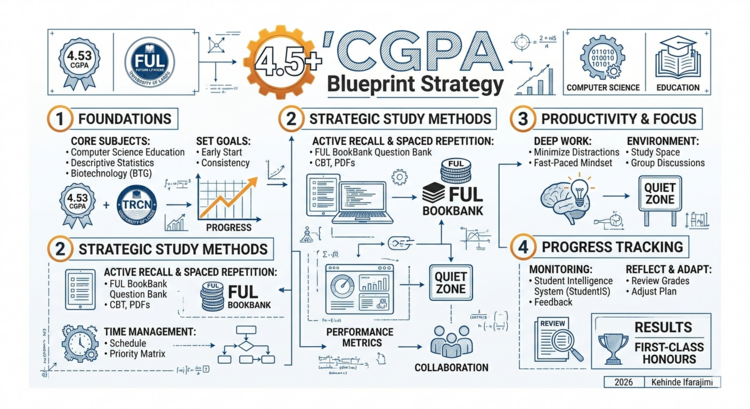 Academic Strategy
A practical planning guide for translating a CGPA target into course priorities, semester decisions, and deliberate weekly study effort.
Use the installation guide if you prefer faster app access, while the full website remains available from any modern browser.